Executive summary
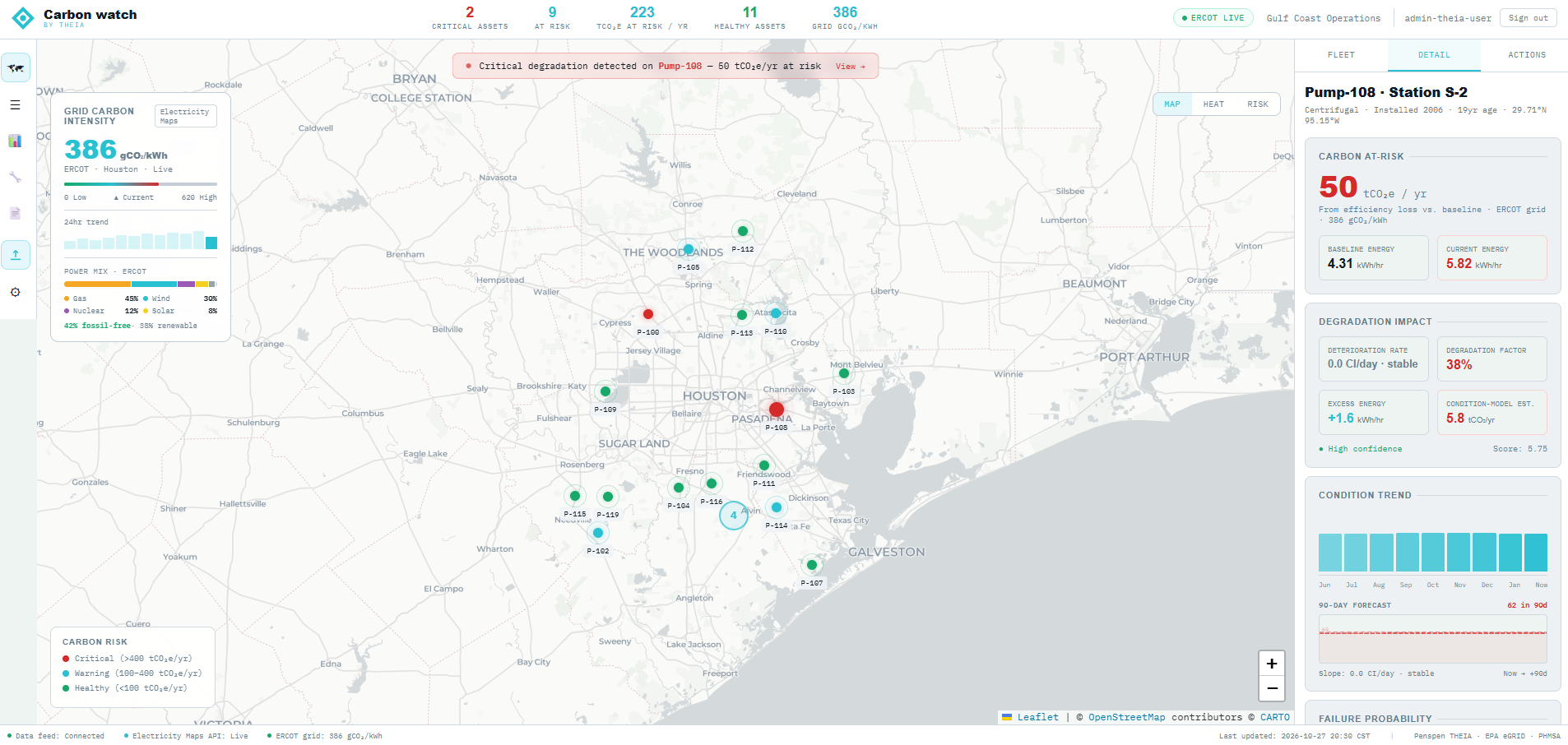
Carbon Watch was the team’s winning entry in the Best Visualization category at the global Sidara × Microsoft Hackathon. Working across Penspen and Perkins&Will, the team built an operational view that connects asset condition, energy inefficiency, carbon intensity, and maintenance decisions.
The problem
Asset-heavy operators often manage maintenance and decarbonization as separate concerns. Carbon Watch treats maintenance as a practical emissions-reduction lever by identifying degraded equipment that consumes more energy and ranking interventions by their potential carbon impact.
How the solution works
Operators ingest asset, sensor, and maintenance data, monitor the fleet, identify high-risk assets, inspect diagnostics, and select targeted actions. Microsoft Fabric separates raw ingestion, structured transformation, and analytical enrichment through Bronze, Silver, and Gold layers.
An explainable expected-energy model estimates normal consumption from operational features such as condition, age, operating hours, maintenance history, and site. Persistent gaps between actual and expected energy become alerts. The platform converts avoidable energy use into a carbon-at-risk measure that can be reviewed by asset, site, or fleet.
Outcome
The result is a shared operational view for earlier degradation detection, more efficient equipment, maintenance prioritization, and measurable decarbonization decisions.